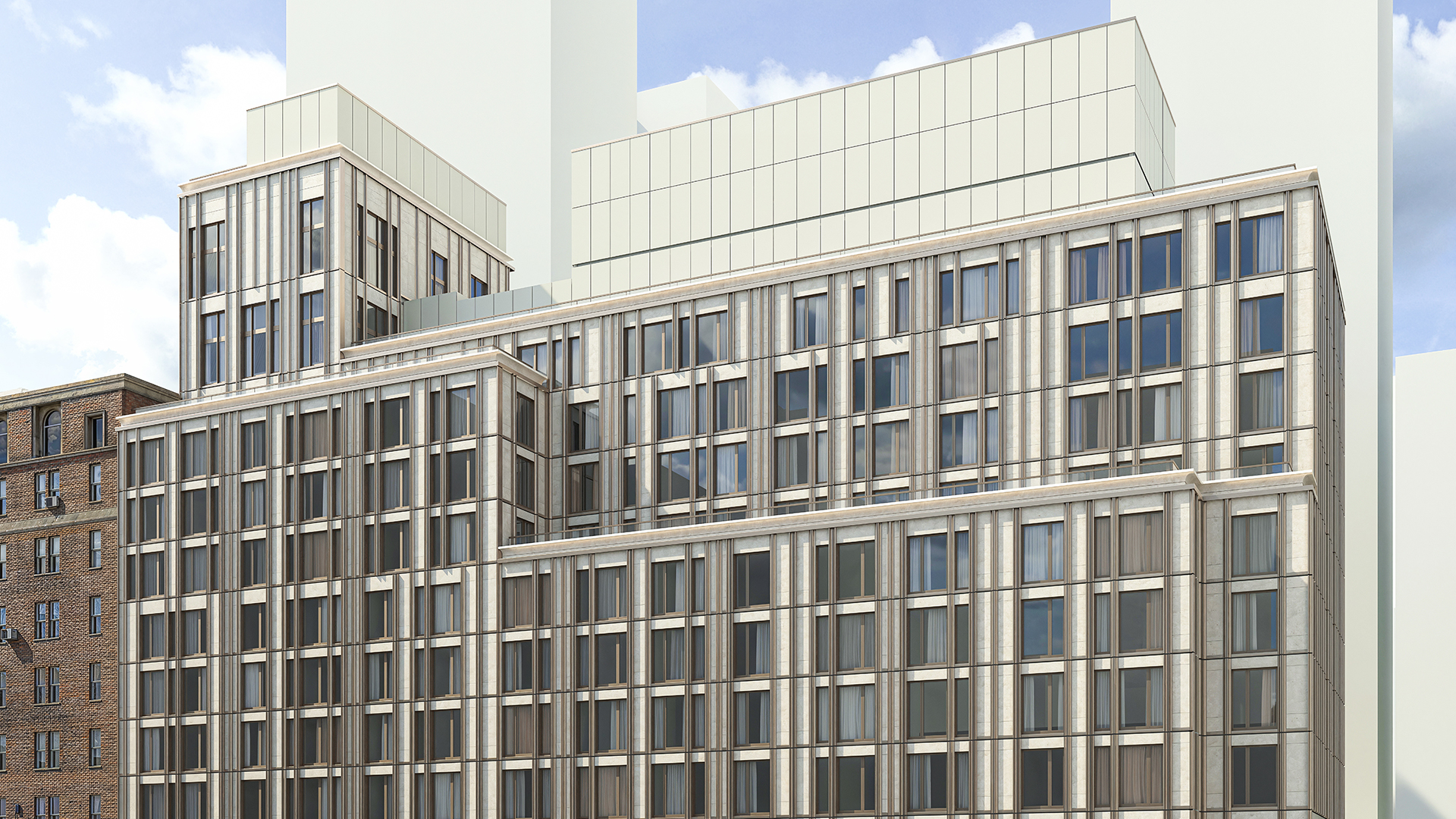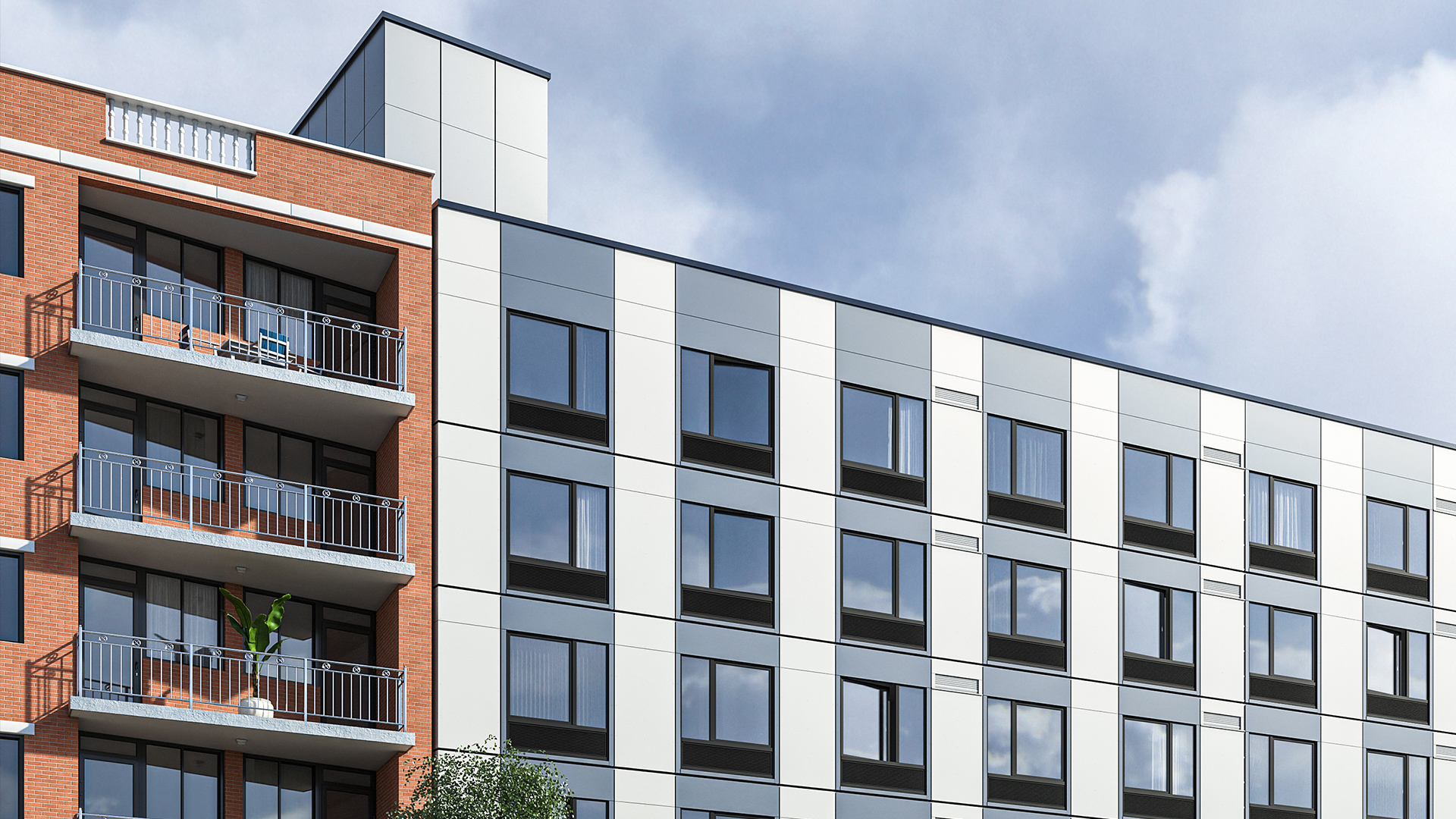

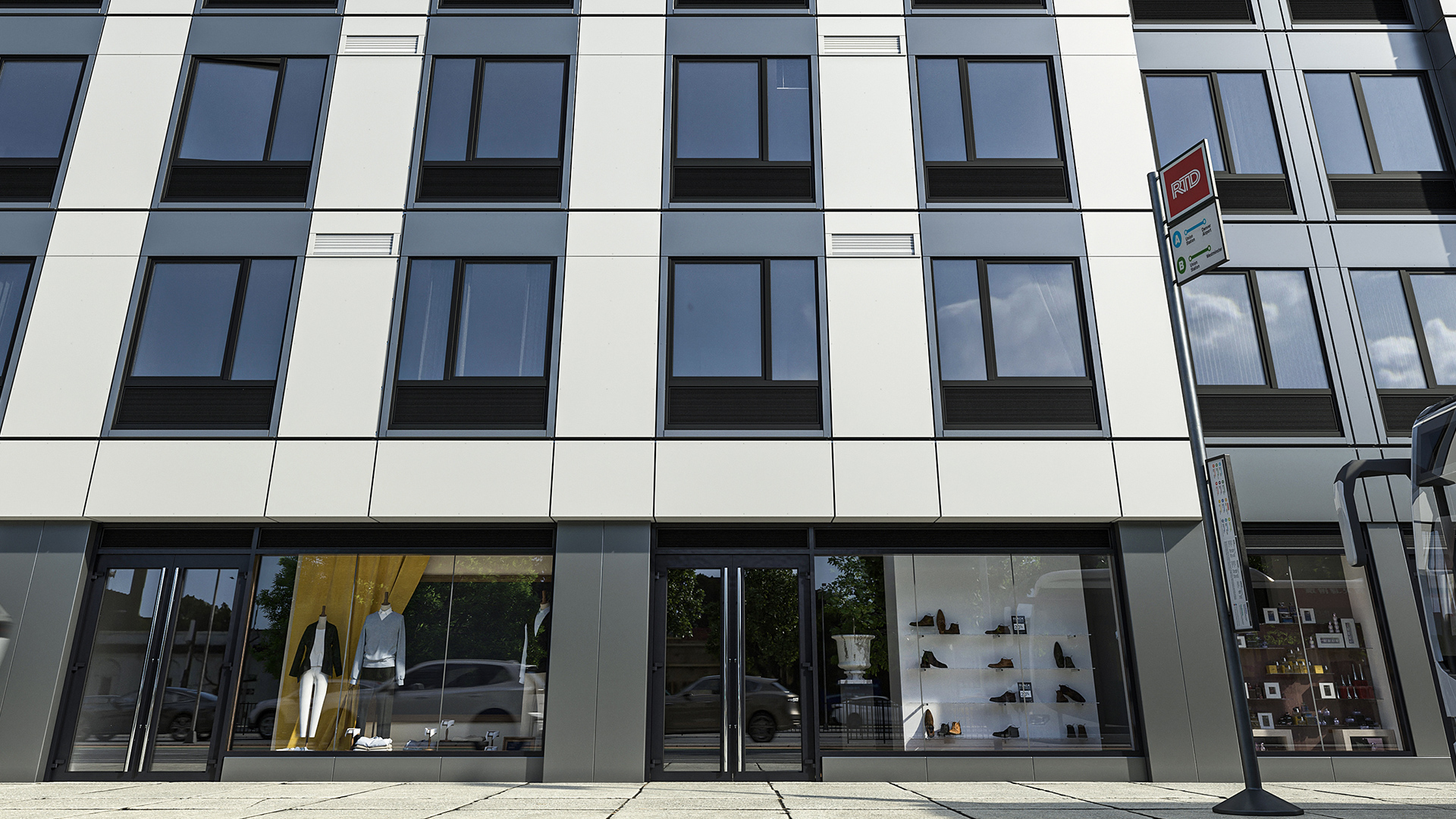
Spandrel panels cover the floor zone — slab edge, insulation, fire safing, and mechanical runs between floors. Vision glass fills the transparent zone between floors for daylight and exterior views. The boundary between them determines the curtain wall module, sets LOD zone assignments in Revit, and defines what the facade conceals from the street.
Spandrel Panel and Vision Glass Serve Different Functions — and the Boundary Between Them Defines the Facade Module
A spandrel panel closes the zone between floor levels: the structural slab edge, edge beam, slab edge insulation, perimeter fire safing, and any mechanical or electrical distribution running through the interstitial space. Vision glass fills the remaining zone between spandrel levels — the transparent aperture for daylight and exterior views.
The height of each zone is a structural parameter. Spandrel zone height is determined by slab depth, insulation thickness, fire safing requirements, and the minimum constructive panel height of the selected curtain wall system. Vision zone height is the remainder of the floor-to-floor dimension after the spandrel is deducted.
When this boundary is wrong, the consequences take two forms: a spandrel zone that is too narrow leaves the slab edge or fire safing visible from the street through the glazing transitions; a spandrel zone that is too tall reduces the vision aperture below what the daylighting program or facade rhythm requires. Both failures surface late — at shop drawing review or during installation — and cost significantly more to resolve at that stage than they would have during schematic design.
Spandrel Panels Come in Three Material Types — Each With Different Performance and Detailing Requirements
Glass spandrel is used where the architectural program requires visual continuity of a glazed facade. Three variants achieve the required opacity:
- Ceramic frit: sintered ceramic material fused to the glass surface at 600°C and above. ASTM C1048 governs heat-strengthening of ceramic frit glass. The material bonds permanently with the glass — it does not delaminate, degrade in moisture, or respond to thermal cycling in the concealed cavity. Ceramic frit is the most durable option for glass spandrel applications.
- Backpainted glass: paint applied to the #4 surface of the insulating glass unit (the interior face of the inner lite). GANA — the Glass Association of North America — does not recommend backpainted glass for spandrel applications: paint degrades from heat and moisture in the concealed cavity behind the panel, causing color shift and delamination.
- Opaque IGU backing: an opaque insulation board or dark material positioned between the glass lites of the insulating unit to achieve the required opacity without surface treatment.
Metal spandrel includes aluminum panels with powder or liquid coating, anodized aluminum, and composite aluminum panel (ACM) — two thin aluminum sheets bonded to a mineral or polyethylene core. Metal spandrel does not require the thermal cavity management that glass spandrel demands.
Composite spandrel — terracotta (fired clay), natural stone in a metal frame, GRC (Glass Fiber Reinforced Concrete, a low-mass concrete panel reinforced with glass fiber) — is used where the architectural program calls for expressed materiality or textural variation across facade zones.
The critical technical point for glass spandrel: the concealed air cavity between the back face of the glass panel and the interior construction accumulates heat absorbed by the dark backing material from solar radiation. IGMA — the Insulating Glass Manufacturers Alliance — recommends keeping edge seal temperatures below 82°C (180°F) to maintain IGU edge seal integrity. Without a ventilation or pressure equalization detail, this threshold can be exceeded under direct solar exposure, accelerating edge seal degradation and increasing the risk of thermal glass fracture.
Vision Glass Performance Is Defined by Three Variables — VLT, SHGC, and U-Factor
Vision glass is the transparent curtain wall panel. Its performance is described by three primary variables:
- VLT (Visible Light Transmittance): the fraction of the visible solar spectrum transmitted through the glazing. Higher VLT means more daylight; typical commercial values range from 40–70%.
- SHGC (Solar Heat Gain Coefficient): the fraction of solar radiation admitted as heat. Higher SHGC means more passive heat gain — an advantage in cold climates, a liability in warm ones. Low-e coatings reduce SHGC without significantly reducing VLT.
- U-factor: the thermal transmittance of the glazing assembly. Lower U-factor means better thermal insulation. Low-e coatings with noble-gas filling substantially reduce U-factor compared to uncoated or single-pane glazing.
Low-e (low-emissivity) coating — a thin metallic or metal-oxide layer on the glass surface — reflects long-wave infrared radiation while transmitting visible light. This is the standard configuration for commercial facades in most climate zones.
Vision panels open views in both directions. Everything immediately behind the vision zone — the adjacent slab edge, insulation, fire safing — is potentially visible from the street or from neighboring buildings. The spandrel zone must be tall enough to completely block that line of sight.
Ceramic frit on vision glass: partial application (20–50% coverage) reduces solar loading while preserving partial transparency. Full fritting (90% coverage and above) makes the panel functionally equivalent to a spandrel in terms of opacity. This distinction matters for LOD zone assignments in Revit: a fully fritted panel is classified as an opaque element and must be modeled accordingly — regardless of the fact that the material is glass.
The Spandrel Zone Stack-Up Is Where Coordination Between Architect and Structural Engineer Breaks Down
The spandrel zone height is not a single dimension — it is a sum of several independent requirements:
- Slab thickness: set by the structural engineer based on span and load calculations
- Slab edge insulation: a thermal requirement to prevent a heat bridge through the concrete slab edge
- Mechanical or service clearance, if distribution runs require space in this zone
- Minimum constructive height of the spandrel panel in the selected curtain wall system
- Fire safing: the fire-stopping material filling the gap between the lower edge of the curtain wall and the slab edge — governed by ASTM E2307
When this combined dimension is not coordinated between architect and structural engineer before design development, conflicts appear at shop drawing review or during installation. Two common scenarios: the spandrel zone is too narrow — and the slab edge or fire safing falls within the line of sight through transparent transitions; the spandrel zone is too wide — and the vision aperture is smaller than the daylighting program or approved facade rhythm requires.
This interface belongs to LOD 350: it sits between the architect (facade grid geometry) and the structural engineer (slab edge conditions). Without an explicit responsibility assignment in the BIM Execution Plan, this node stays undefined until shop drawing review — the most expensive place to resolve it. For more on when LOD 350 arises and what it resolves, see LOD 300 vs LOD 400.
Glass Spandrel Panels Require Specific Thermal Detailing — the Concealed Cavity Overheats Without It
The concealed cavity behind a glass spandrel is not a neutral space. Under direct solar exposure, the dark backing material absorbs a significant share of solar radiation. Without ventilation, the air temperature in the cavity can substantially exceed the threshold above which IGMA documents accelerated edge seal degradation — 82°C (180°F). The consequences: premature seal failure, loss of the IGU noble-gas fill, condensation between the glass lites, and the potential for thermal fracture.
Two engineering approaches address this:
- Ventilated cavity: openings at the bottom and top of the spandrel zone allow exterior air to circulate through the cavity and carry heat away from the back face of the panel.
- Pressure-equalized cavity: the system is detailed so that pressure in the cavity equalizes with exterior air pressure, minimizing the movement of humid air inward while maintaining controlled thermal exchange.
Fire safing in the spandrel zone is a separate technical requirement. ASTM E2307 governs perimeter fire containment: mineral wool or certified intumescent materials fill the gap between the lower edge of the curtain wall system and the slab edge. The spandrel zone must be tall enough to accommodate the fire safing assembly without conflict with the curtain wall anchors. When this requirement is not accounted for at LOD 100 and LOD 200, it surfaces at shop drawing review as a geometric conflict between bracket locations and fire-stopping material.
The Spandrel/Vision Split in Revit Is an LOD 100 Decision — Not a Detail Question
The first parametric decision in Revit for a curtain wall project is grid zone assignment: which rows are opaque (spandrel), which are transparent (vision). This is LOD 100. Deferring or getting this decision wrong generates consequences at later stages that cost disproportionately more to fix.
The common over-modeling failure: the team begins schematic design and immediately models the spandrel assembly at LOD 300 — with specific panel dimensions, backing type, and anchor details. The structural engineer subsequently updates the slab depth: it increases by 50mm after load calculations. The entire spandrel zone requires remodeling. What would have been a formula field edit at LOD 100 becomes rework across multiple model elements. For more on what over-modeling costs at each phase, see what LOD architects actually need.
Kora Studio — a Revit-native facade design plugin built specifically for unitized curtain wall systems — is designed around this approach. Kora Studio Grid Editor lets architects define spandrel/vision zone assignments at LOD 100 directly inside Revit: which grid rows are opaque panels, which rows contain a window. Dimensions are set through formula-driven fields — changing the spandrel zone height or floor-to-floor module updates through the formula, without manual remodeling of individual elements.
One important boundary: Kora Studio supports opaque panels (spandrel zone) and panels with a window. Full vision glass panels — fully transparent, without an inserted element — are outside Kora's supported scope. Grid Editor defines where the spandrel is and where the window is, but the transparent glass fill in the vision zone itself sits outside the plugin's functionality.
When schematic design is complete and the zone layout is approved, the Kora Studio LOD 100 model becomes the coordination foundation for LOD 300 construction documentation — not a throwaway file rebuilt from scratch. To see what a LOD 100 facade zone workflow looks like inside Revit, book a demo. For examples of how spandrel/vision zoning applies across project types, see Kora Studio use cases.
FAQ
What is the difference between spandrel glass and vision glass in curtain wall?
Spandrel glass and vision glass are different functional zones of the same facade system — not two materials. Vision glass is the transparent panel that transmits daylight and provides exterior views. Spandrel glass is an opaque or semi-opaque panel that conceals the slab edge, insulation, and the interstitial space between floors. From the exterior, both zones can appear as glass — for example, when the spandrel is ceramic frit on a glass substrate — but their physical properties, detailing requirements, and installation logic are fundamentally different.
Why do glass spandrel panels require special thermal detailing?
The concealed cavity behind a glass spandrel heats up from solar radiation absorbed by the dark backing material. Without ventilation or a pressure equalization detail, cavity temperature can exceed 82°C (180°F) — the threshold above which IGMA documents accelerated IGU edge seal degradation. The consequence is premature seal failure, loss of the noble-gas fill, condensation between the glass lites, and potential thermal fracture. This is not a rare failure mode: it occurs in any project where glass spandrel is detailed without accounting for the thermal behavior of the concealed cavity.
How do you determine the correct spandrel panel height in curtain wall design?
The spandrel zone height is a sum of several dimensions: slab thickness (set by the structural engineer), slab edge insulation thickness, the minimum constructive height of the spandrel panel in the selected system, and space for fire safing per ASTM E2307. None of these dimensions are set by the architect alone — all require coordination with the structural engineer and fire protection consultant. This is why the spandrel zone height must be established before LOD 300, ideally resolved during schematic design before the facade grid is committed. For a phase-by-phase look at interdisciplinary coordination on facade projects, see what LOD architects actually need.
At what point in the design process should the spandrel/vision split be defined?
The spandrel/vision split is an LOD 100 decision — schematic design. At this stage, the team defines where the boundary falls between opaque and transparent zones, what the height of each row is, and what the overall modular logic of the facade will be. Deferring this decision to design development or construction documents means that all downstream coordination — with the structural engineer on slab edge conditions, with the fire protection consultant on fire safing clearances — is built on an unresolved foundation. The result is panel layout rework and shop drawing conflicts. For examples of how this workflow applies across project types, see Kora Studio use cases.
Can fritted glass be used as a spandrel panel?
Yes — and it is common practice. A fully fritted glass panel (full ceramic frit, 90% coverage and above) achieves the opacity level that spandrel requires, and is used where the architectural program calls for visual continuity of the glazed envelope with a minimally expressed zone boundary. Partial fritting (20–50% coverage) is applied to vision panels to reduce solar loading without eliminating transparency. The key distinction for LOD zone assignments: a fully fritted panel is classified as an opaque element and must be modeled accordingly in Revit — regardless of the fact that the base material is glass. For a step-by-step look at how to model curtain wall systems in Revit, see curtain wall families in Revit.