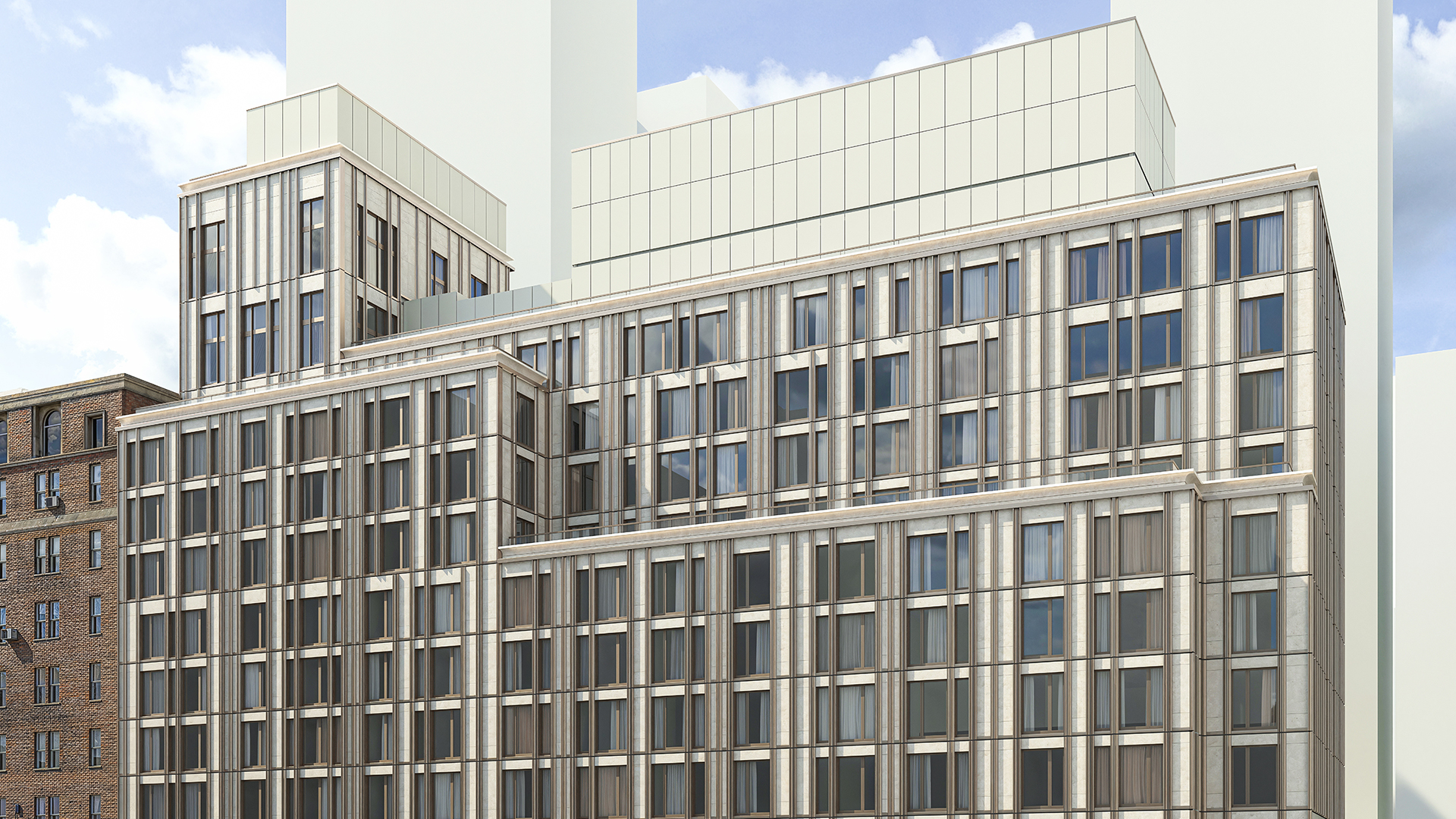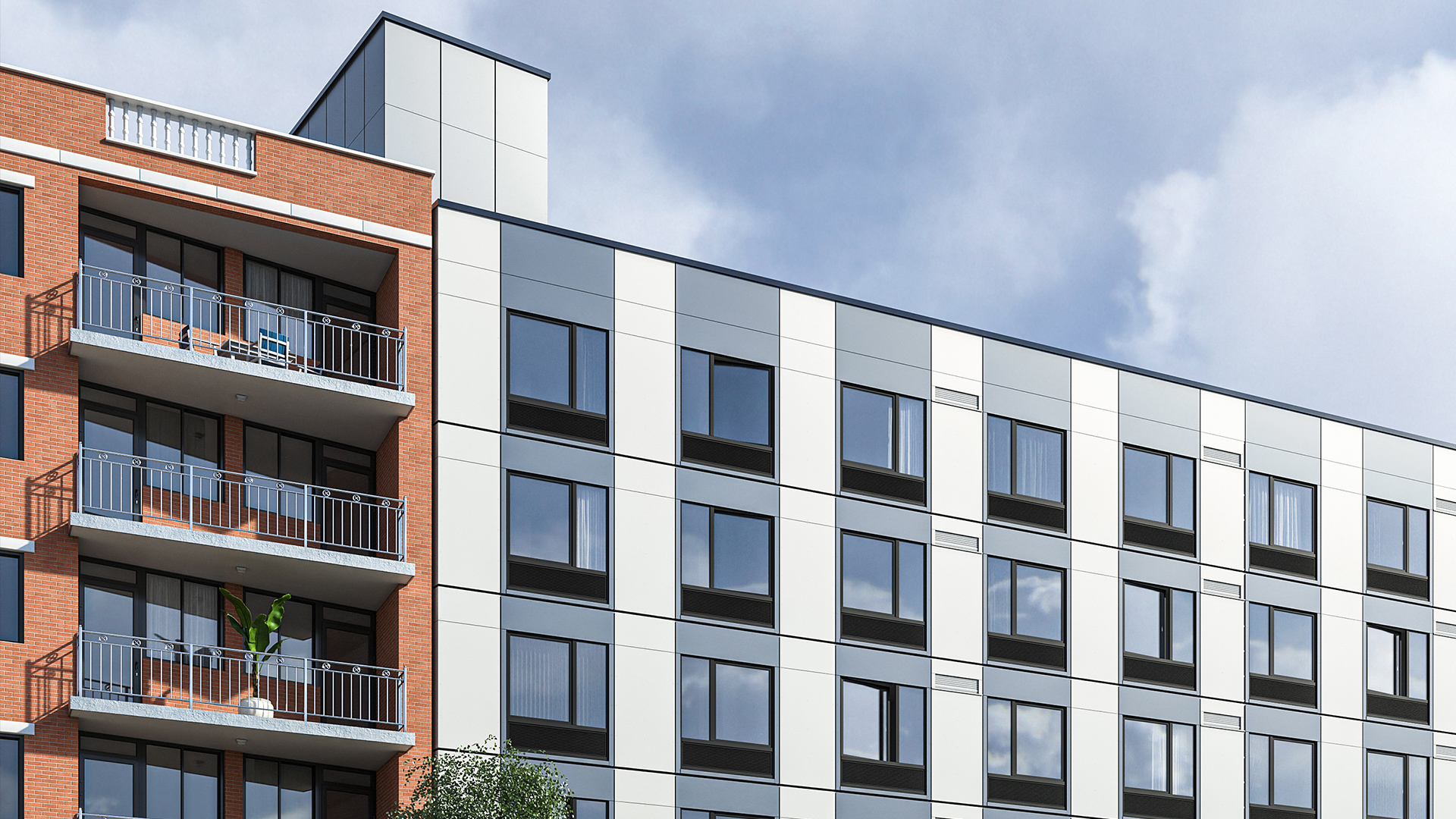

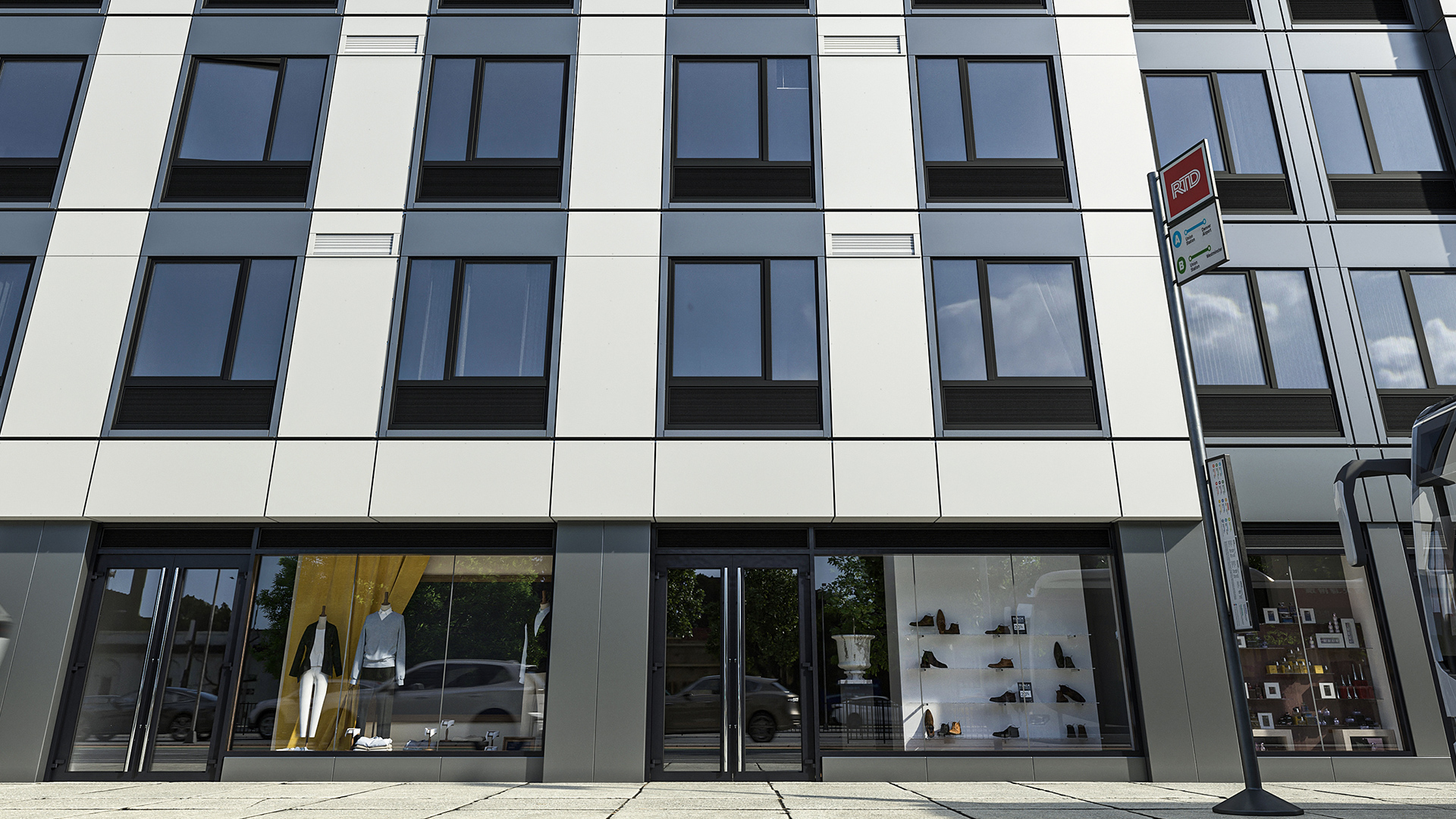
Unitized and stick-built curtain wall are not two versions of the same thing. They are two different manufacturing and installation processes, each suited to specific project conditions. A unitized system is fully assembled at the factory — glass, gaskets, and anchors included — and lifted into place as a complete panel. A stick-built system is assembled on-site, piece by piece: vertical mullions first, then horizontals, then individual glazing units and spandrels. Where the assembly happens determines everything that follows — quality, schedule, and LOD sequencing.
How Each System Works — The Assembly Logic That Drives Everything Else
A unitized curtain wall is serial factory production. Typical panel dimensions: 1.2–2.1 m wide and 3.5–4.3 m tall, sized to match the floor-to-floor height. Each panel leaves the production line fully assembled: the glazing unit or spandrel element is already set, gaskets are installed and tested, and anchors are ready to connect to brackets embedded in the slab. On-site, panels are lifted by crane and clipped to anchors one floor at a time. Adjacent panels connect through 12–20 mm inter-panel joints. The building envelope closes quickly.
A stick-built system runs the sequence in reverse. Vertical aluminum mullions are anchored to the structural frame first. Horizontal transoms are added next, via clips or spline connections. Then individual glazing units and spandrels are inserted into the framework. Each component is a separate installation step on an open site. The system is flexible in the field — and much slower to close.
Where Unitized Systems Perform Best
Unitized curtain wall is designed for scale and repetition. On high-rise projects of 20 floors and above, it is the standard choice: scaffolding for stick installation at that height is impractical and expensive, while a crane is already on-site for material lifts. When the facade geometry is regular — consistent panel widths, level floors, standard module — the factory line produces identical elements efficiently, and unit cost drops as the production run grows.
Schedule is one of the strongest arguments. Installing unitized panels by crane runs roughly three times faster than piece-by-piece stick assembly. The building envelope closes sooner, interior work starts earlier, and weather-related delay risk is reduced.
In seismic regions, unitized systems also carry a structural advantage. Standard curtain wall systems are designed to absorb up to 75 mm of relative inter-story displacement without glass breakage or loss of weathertightness. Unitized construction has fewer field joints — fewer points of potential movement and risk.
Quality control is factory-controlled. Every unitized panel is air- and water-tested before shipment, under controlled conditions isolated from weather, dust, and workmanship variability. Stick-built systems are tested after installation on the open site — the outcome depends on conditions and crew skill.
Where Unitized Falls Short
Unitized curtain wall handles non-standard geometry poorly. Re-entrant corners, strongly variable panel sizes, and complex transitions between facade planes push against the logic of factory production. Every exception from the standard module requires a separate manufacturing solution — and that costs money.
Corner panels carry a specific technical requirement that cannot be ignored during design: the corner element must be dimensioned slightly smaller than a standard panel to allow three-dimensional maneuvering during crane installation. If this allowance is not built into the design geometry during design development, corner installation becomes a problem.
Small volumes also limit unitized efficiency. Setting up a production line for a small order costs nearly as much as for a large one — so for smaller-scale projects, the per-unit cost rises disproportionately.
Tolerance mismatch is another technical constraint. The structural frame carries a tolerance of ±25 mm; the unitized curtain wall system is designed for ±12 mm. The gap must be absorbed by the anchor system, which needs sufficient three-axis adjustability built in. If this difference is not addressed in the anchor detail design, panel installation creates problems.
The biggest risk for the BIM team: fabrication lead times of 6–12 months create pressure to lock in panel specifications long before the design can be owner-approved. Teams that fall into this trap may find themselves rebuilding the fabrication model after a design change — exactly the failure mode described in LOD 300 vs LOD 400.
Where Stick-Built Performs Best
Stick-built curtain wall is the right call for projects with non-standard geometry or small volumes. When the facade has complex transitions between planes, unusual angles, or strongly variable bay sizes, field assembly allows adjustment where factory logic cannot adapt.
For buildings of 3–12 floors, the cost balance shifts toward stick: no production line setup costs, no minimum production run, no long fabrication lead times. If the project allows design development to continue into late stages, stick preserves that flexibility.
In markets with limited access to specialized factory production, stick-built is often the only realistic option — regardless of building height.
Where Stick Falls Short
Extended open-site construction is stick's primary vulnerability. Every component is installed individually on an open site, which means exposure to weather, dust, and workmanship variability at every step. Delayed building enclosure extends the window of risk for interior work.
Above 12–15 floors, the cost and safety requirements for scaffolding make stick installation impractical. For high-rise projects, this is not a preference question — it's a logistics one.
Quality is entirely site-dependent. There is no factory-controlled testing, no pre-shipment air or water certification. The outcome is determined by the conditions on a specific site and the skill of the installation crew.
Choosing Between Systems — What Each Project Condition Points To
Unitized curtain wall fits when:
- The building is 20+ floors with cranes already on-site
- The facade geometry is regular and repeating
- The project volume is 5,000 m² or more
- The schedule requires fast envelope closure
- The project is in a seismically active region
- Factory quality control is a priority
Stick-built fits when:
- The building is 3–12 floors
- The facade geometry is complex, non-standard, or highly variable
- The project volume is small or mid-size
- The design may still change into late project stages
- Access to specialized factory production is limited
A hybrid approach is also valid. One building can use both systems in different zones — unitized for the repetitive floor plates where factory efficiency is justified, stick for complex corner conditions or non-standard lower levels. This is not a compromise; it is the technically correct answer when project conditions vary across the facade. For examples of how this logic applies across project types, see Kora Studio facade project use cases.
What the System Choice Means for LOD Sequencing in Revit
The decision between unitized and stick-built is not only a manufacturing decision. It determines when and to what LOD the facade needs to be modeled — and who carries responsibility at each stage. For a full phase-by-phase breakdown, see what LOD architects need at each project stage.
For unitized systems, the time pressure is most acute: 6–12 month fabrication lead times mean the facade contractor needs LOD 400 well before construction documents are complete. Teams that yield to this pressure link the Revit model to a specific manufacturer's component catalog before the design is approved. When the design changes — and on complex facades it often does — they rebuild the fabrication model rather than revise it. For more on this failure mode and how it compounds, see LOD 300 vs LOD 400.
Kora Studio — a Revit-native facade design plugin built specifically for unitized curtain wall systems — addresses this sequencing problem at the source. Kora Studio Grid Editor lets architects define panel spacing, floor-to-floor module heights, and cladding zone assignments at LOD 100 inside Revit, using formula-driven dimension fields — without linking to any manufacturer's panel catalog. The design stays flexible through schematic design. When the owner approves the direction, the Kora Studio LOD 100 model becomes the coordination foundation for LOD 300 construction documentation, not a throwaway file rebuilt from scratch.
To see what a LOD 100 unitized facade workflow looks like inside Revit, book a demo.
FAQ
Can the same building use both unitized and stick-built curtain wall? Yes — and it is common practice on complex projects. A typical scenario: unitized for the repetitive floor plates with a regular module, stick-built for lower levels with complex geometry or non-standard corner conditions. The critical step is defining the boundary between systems during design development, since each system carries a different LOD sequence, different contractor, and different tolerance requirements. Leaving the boundary undefined creates coordination conflicts when the two systems meet. For examples of how this plays out across project types, see Kora Studio project use cases.
What is a typical fabrication lead time for unitized curtain wall? Fabrication lead times for unitized curtain wall systems typically run from 6 to 12 months — measured from finalized shop drawings to delivery on-site. This lead time is the primary source of schedule pressure on LOD escalation: the fabricator needs precise panel specifications well before construction documents are complete. Teams that don't account for this lead time in phase planning often find the schedule forcing them to LOD 400 before the design is approved by the owner. For how this affects the LOD sequence in practice, see LOD 300 vs LOD 400.
How do corner conditions work on unitized curtain wall systems? Corner panels on unitized systems must be dimensioned slightly smaller than standard modules — this allows the three-dimensional maneuvering required during crane installation. If this allowance is not built into the project geometry during design development, corner installation becomes a problem that surfaces during shop drawing review. Some facade contractors resolve corner conditions using proprietary corner units or inter-system transition elements; others design purpose-built corner modules. In all cases, the corner requires an explicit design decision — not treatment as a standard panel.
Is stick-built curtain wall less watertight than unitized? Both systems can achieve equivalent weathertightness — the difference is where and how failure risk arises. Unitized systems are factory-tested before shipment and have fewer field joints where water infiltration can occur. Stick-built systems are tested after installation on the open site; seal quality depends on site conditions and crew skill. Both systems are vulnerable to long-term gasket degradation and inadequate weep hole maintenance. Neither is inherently more watertight given proper installation and maintenance — but unitized systematically reduces field variables, which lowers the probability of installation-related water infiltration.
At what building height does unitized curtain wall become more practical than stick? The practical threshold is around 12–15 floors. Below that, scaffolding costs and logistics for stick installation remain manageable; above it, they become a dominant cost and schedule factor. But height is not the only variable. Even on a 10-story building, unitized may be the better choice if the facade geometry is regular, the schedule is tight, and the volume is sufficient for efficient factory production. The decision involves height, volume, geometry, and schedule simultaneously — no single variable determines it alone. For how curtain wall families work in Revit — system types, loadable panels, and grid rules — see curtain wall system vs loadable families in Revit.